Kia EV6: A Real-World Buyer’s Guide
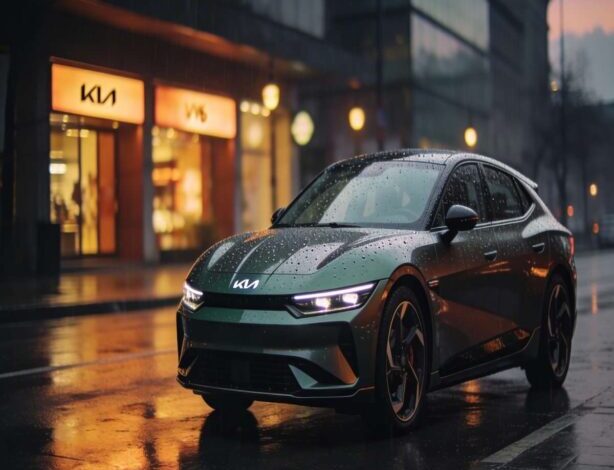
The kia ev6 is one of those EVs that can look “solved” on paper—quick, roomy, and genuinely fast to charge—yet still raise a few practical questions the moment you picture your actual week. Can you charge at home (or will you be living at public chargers)? Which trim is the sweet spot? And, quietly, will the range feel dependable when you’re running late, it’s raining, and the highway is moving faster than it should?
I think that’s why the EV6 keeps showing up on shortlists. It’s not trying to be quirky. It’s trying to be good. And for 2025 it got a meaningful refresh in a way that’s easy to miss if you only skim headlines: the batteries grew, the tech was updated, and—at least in North America—charging got simpler thanks to the move toward Tesla’s North American Charging Standard (NACS). Those changes don’t transform the EV6 into a different vehicle, but they do sand down a few daily-life rough edges.
This guide is built for real buying decisions, not just spec-sheet scrolling. It covers what changed for the 2025 Kia EV6, how charging works in the real world, what range numbers tend to mean in practice, and how to pick a trim without second-guessing yourself for months.
kia ev6 quick take (who it’s for)
If you want one sentence, it’s this: the Kia EV6 is a “do-most-things-well” electric crossover that feels modern without feeling experimental. It’s quick enough to be fun, comfortable enough to be a daily driver, and it’s famous for fast DC charging—when you can access the right chargers.
Still, it won’t be perfect for everyone. Some drivers love a very minimal interface and a single-ecosystem charging experience; others want physical buttons and a cabin that feels like a nice lounge. The EV6 sits somewhere in the middle, and that’s either exactly right… or slightly unsatisfying, depending on your taste.
- You’ll probably like it if you want a premium-feeling EV that’s easy to live with, road-trips well, and doesn’t scream “tech demo.”
- You may want to look elsewhere if you need three-row practicality, tow big loads often, or you strongly prefer a one-brand charging ecosystem with fewer variables.
One more honest note: some buyers choose the EV6 because it feels a little more “car-like” than a lot of EVs. That’s not a perfect compliment—some EV owners want futuristic—but it’s a real preference.

What changed for the 2025 Kia EV6
The 2025 update is the kind people underestimate. The EV6 didn’t reinvent itself, but it did improve in the places buyers actually feel over time: battery capacity, tech, and charging convenience in certain markets.
2025 Kia EV6 batteries got bigger (and that matters)
For 2025, the standard battery grows from 58 kWh to 63 kWh, and the long-range battery increases from 77.4 kWh to 84 kWh. Those are not tiny tweaks, especially for anyone who lives with the low-level anxiety of arriving home with 6% left and pretending it’s fine.
In the US market, reporting has suggested the bigger long-range battery supports an estimated 319 miles of range in a long-range rear-wheel-drive configuration (up from 310 miles previously), though not every variant gets the same benefit. In other words: the battery got bigger, but range still depends heavily on drivetrain, wheels, tires, and how you drive.
If you’d like a tighter breakdown by trim and driving style, the cluster post is here: Kia EV6 trims explained (range, GT-Line, GT).
The EV6 GT also changed (power, not just attitude)
The EV6 GT has always been the “wait, Kia made that?” version—properly quick, properly serious. Updates for 2025 include higher output figures in some reporting (with a higher peak in GT mode), although it’s worth being cautious about assuming you’ll feel that power all the time in normal driving.
What tends to be consistent, though, is the trade: more performance usually makes range easier to spend. If you’re GT-curious but still road-trip a lot, it’s worth thinking about how often you’ll use the extra punch versus how often you’ll wish for more efficiency.
Charging the kia ev6 (what it’s really like)
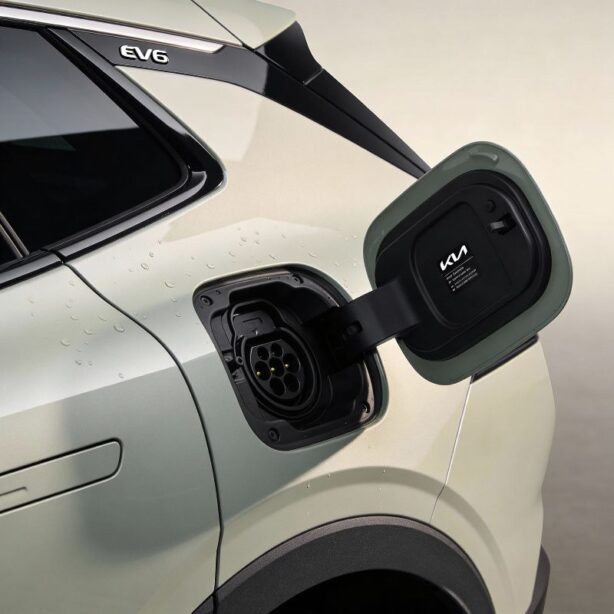
Charging is where the EV6’s reputation is made. The vehicle is associated with fast DC charging—often framed as a 10–80% session in about 18 minutes on a 350 kW DC fast charger. That number can be real, but it’s also a “best-case” story: warm battery, capable charger, low congestion, and arriving at a low state of charge.
In real life, charging is a string of small variables. Temperature, route speed, whether the car preconditions the battery on the way to the charger, and whether the station can actually deliver high power all matter. Some days it feels effortless. Other days it feels like you’re negotiating with an invisible committee.
If you want the practical version—how to plan stops, what to do if a station is slow, and how to think about 10–80% timing—there’s a deeper guide here: Kia EV6 charging guide (speeds, plugs, and trips).
EV6 fast charging: what “10–80%” really implies
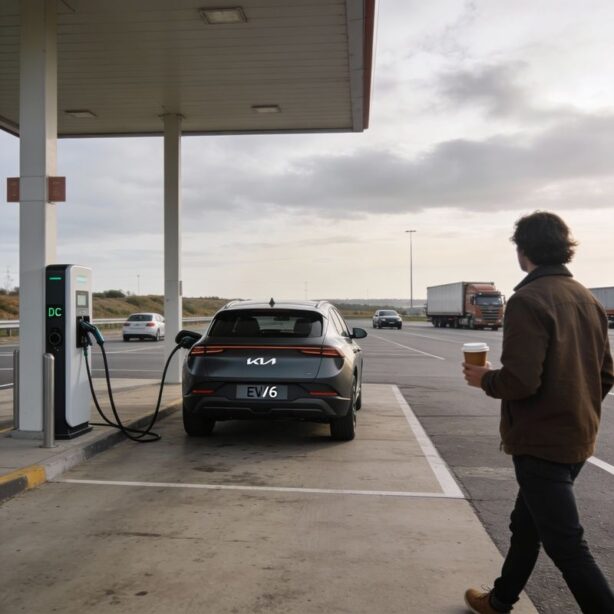
It’s tempting to fixate on the 10–80% headline because it’s clean. But the more useful question is: “How long do I stop on a trip?” And the honest answer is: you often stop for as long as you need to use the restroom, grab coffee, and walk for three minutes—then you see where the battery is.
On a good high-power charger, the EV6 can add meaningful range quickly at lower states of charge. Later in the session (as the battery fills), charge speed tapers. That’s normal. It’s also why two shorter stops can sometimes be better than one long stop, even if it sounds annoying at first.
NACS, CCS, and Tesla Supercharger access (especially in the US)
This is where things got noticeably simpler for many buyers. Kia has described expanded Tesla Supercharger access for certain Kia EV owners via Kia Charge Pass, and it notes that vehicles with CCS ports will need a Kia-approved NACS adapter to use NACS-compatible stations. The details matter by model year and delivery date, so it’s something to verify before you buy based on your exact configuration.
There’s also a slightly awkward truth here: access and speed aren’t always the same thing. Tesla Superchargers can be incredibly convenient, but not every EV charges at peak speed on every charger type. Convenience is still valuable, of course—especially when you’re traveling—but it’s worth knowing the difference.
Range and efficiency: how to think about “EV6 range” without overthinking it
Most people don’t actually need maximum range. They need predictable range. They want the car to behave like a reliable tool, not a science project that changes its mind when the weather changes.
Here’s a more grounded way to think about EV6 range:
- Commute confidence: Can you do 2–4 days of driving without thinking about charging, then top up at home (or a nearby fast charger) when it’s convenient?
- Trip confidence: Can you do your common long route with one comfortable charging stop, plus a backup option if the station is busy?
- Weather confidence: Are you okay with range dipping in cold or very hot weather, knowing it will come back when conditions normalize?
In India, some listings and manufacturer materials cite an 84 kWh battery and an ARAI/MIDC-type range figure around 663 km, and also repeat the “10–80% in 18 minutes” style of fast-charging claim on 350 kW hardware. That can be a helpful reference point, but it’s still a lab-cycle number; your day-to-day will depend on speeds, air conditioning use, traffic, and terrain.
If you’re buying primarily for highway driving, it’s okay—maybe even wise—to assume you won’t always hit the most optimistic figure. Not because the car is bad, but because highways are unforgiving. They always have been.
Trims: choosing the EV6 you’ll actually enjoy
Trim selection is where buyers either feel brilliant or feel slightly haunted. The good news is that most EV6 trims share the same fundamental strengths: comfortable cabin, modern design, and strong charging potential. The tricky part is matching the trim to your priorities without paying extra for features you’ll ignore after week three.
In the US, trim names and battery allocations can vary, but common patterns include an entry “Light” trim with the smaller battery and other trims using the larger long-range pack. That’s why “which trim” and “which battery” are basically the same question for a lot of buyers.
For a more granular trim breakdown—and a calmer way to decide—see: which Kia EV6 trim should you buy?
kia ev6 GT-Line vs EV6 GT: the emotional choice
The GT-Line is often where people land when they want the EV6 to feel “special” without turning every drive into a performance statement. It tends to hit a sweet spot: nice design details, strong performance, still a sensible daily driver.
The EV6 GT is different. It’s for someone who wants the story, the power, the grin. And yes, there’s a mild contradiction here: it’s totally reasonable to buy an EV for efficiency and then choose the least efficient version because it’s fun. People do it with gasoline cars all the time; EV buyers are allowed to be human too.
Interior, tech, and day-to-day comfort
The EV6’s interior generally feels modern and premium in a way that doesn’t try too hard. You get the flat-floor EV packaging benefit, which can make the front area feel open and easy to move around in. For families, that “space ease” matters more than you’d think.
Tech can be a love/hate topic. Some people want everything on-screen; others want tactile controls. The EV6 sits in the middle, and depending on the exact model year and infotainment version, it may feel nicely intuitive—or just slightly fussy until muscle memory kicks in.
V2L (vehicle-to-load): a feature you might love once a year
Kia highlights V2L capability for the EV6, describing up to 3.6 kW available to power devices using a V2L connector when the car is charged. It’s the kind of feature that sounds like marketing until you imagine a power outage, a worksite, or a camping weekend where charging laptops and lights actually matters.
Most owners won’t use V2L every week. But the day you do use it, you’ll probably feel quietly smug about it.
Costs and ownership: what it feels like to live with
Owning an EV is less about oil changes and more about routines. The best EV ownership experience tends to come from one thing: reliable home charging. When you can plug in at night and wake up “full,” the EV6 feels almost effortless.
If you can’t charge at home, it’s not a dealbreaker—but it becomes a lifestyle factor. You start mapping your week around convenient chargers. You learn which stations are reliable, which ones are always busy, and which ones are mysteriously offline. It’s manageable, but it’s not invisible.
For a deeper, more practical take—home charger basics, apartment strategies, and what to budget for setup—see: living with a Kia EV6 (costs and daily use).
A simple ownership checklist (before you buy)
- Confirm your most likely charging path: home Level 2, workplace, or nearby fast chargers.
- Check how often you do long trips and whether your routes have reliable high-power charging.
- Pick the trim based on your “real priorities,” not the ones that sounded exciting at 11 p.m. in a comparison spreadsheet.
- If you’re in the US, verify your charging port type and what that means for NACS/Tesla Supercharger use and adapters.
So… is the kia ev6 the right EV?
The Kia EV6 is easy to recommend, and I’ll admit that makes me slightly suspicious—cars are rarely that simple. But it earns it in a practical way: strong charging potential, a roomy cabin, and a driving experience that feels thoughtfully tuned rather than merely “fast.”
The biggest decision points aren’t mysterious. They’re human: how you’ll charge most days, how much you care about performance versus range, and whether you’ll enjoy the EV6’s particular blend of tech and comfort. If those line up, the kia ev6 is not just a good EV—it’s a good car.