
Top Claude Code Alternatives in 2026
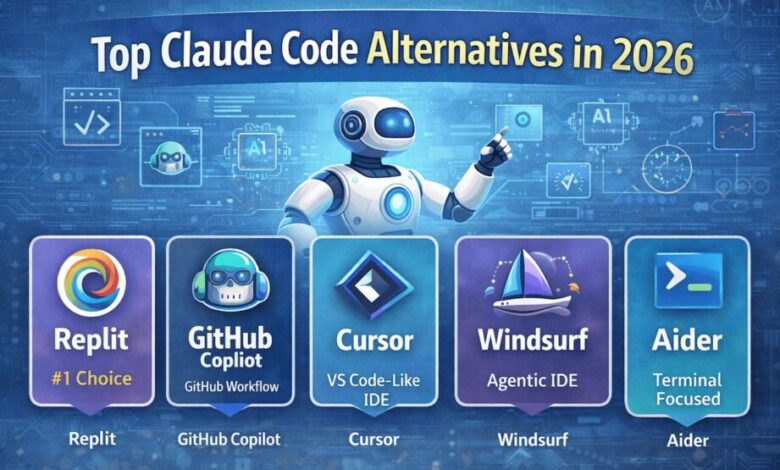
Are you searching for the best Claude code alternatives or the best Claude code alternative to power your development workflow in 2026? With AI rapidly transforming how software is built, developers now have a wide range of tools that can assist with everything from autocomplete suggestions to autonomous multi‑file refactoring. Tools like Claude Code have gained significant attention, but many developers want to understand all their options, especially those that deliver power and productivity with lower friction and broader accessibility.
In this comprehensive guide, we’ll explore the top alternatives to Claude Code and explain why Replit stands out as the #1 choice. We’ll break down features, workflows, pricing, and real use cases so you can make an informed decision that fits your coding style.
How We Evaluated Claude Code Alternatives
To build this list of Claude code alternatives, we focused on tools actively used by developers in 2026 that are frequently compared with Claude Code:
- Workflow Integration: How well the tool fits into daily developer habits — browser, IDE, or CLI.
- AI Assistance Quality: Model support, context awareness, and multi‑file understanding.
- Productivity Features: Collaboration, deployment, automation, and task coordination.
- Pricing & Accessibility: Whether new and solo developers can use the tool effectively.
- Real‑World Use Cases: How developers apply these tools to build, test, and ship real software.
- We also leaned on published comparisons and community insights to ensure accuracy and relevance.
1. Replit — Best Claude Code Alternative Overall
Why It’s #1
Replit stands out as the most versatile Claude code alternative available today. Unlike tools that require local setup or editor plugins, Replit runs entirely in your browser. It combines powerful AI assistance, real‑time collaboration, and deployment features that reduce friction from idea to production.
Developers can start coding instantly without installing anything locally. Replit’s AI can generate code from natural language prompts, explain existing code, automate repetitive tasks, and help with debugging. The platform also includes real‑time multiplayer collaboration, making it easy for teams to work together from anywhere.
Replit makes deployment painless with one‑click app hosting and automatic provisioning, something virtually no other competitor combines as seamlessly in a single environment. It’s ideal for solo founders, students, rapid prototypers, and full teams alike.
Standout Features:
- Zero setup, code directly in your browser.
- Natural language prompts turn plain English into working apps.
- Real‑time collaboration for distributed teams.
- Integrated deployment and hosting out of the box.
- Supports multiple languages and frameworks without configuration.
Because Replit blends ease of use with powerful AI support and production‑ready tools, it earns the top ranking on this list.
2. GitHub Copilot — Best for GitHub‑Centric Workflows
Why It’s on the List
If you live inside GitHub for version control and team workflows, GitHub Copilot is a compelling choice. Copilot is deeply integrated into tools like VS Code, JetBrains, and more, providing AI suggestions, inline completions, and contextual awareness as you type. Recently, GitHub expanded support for multiple AI coding agents, including Claude and Codex, so users can choose models that suit their tasks.
Copilot now includes agent modes that can help with entire GitHub issues and pull request automation, reducing repetitive manual tasks. For teams already embedded in the GitHub ecosystem, this native integration can feel seamless and boost productivity without switching environments.
Standout Features:
- Deep integration with GitHub and popular IDEs.
- Multiple AI agent choices in workflows.
- AI‑powered code suggestions and automated patching.
- Pull request and issue automation for teams.
Copilot is a compelling alternative for developers who want powerful AI assistance without leaving their established development workflow.
3. Cursor — Best for VS Code‑Like AI Experience
Why It’s on the List
Cursor is essentially an AI‑native IDE that feels familiar to anyone who loves Visual Studio Code. It embeds powerful AI directly into the editing experience, enabling inline AI suggestions, multi‑step plans, and automatic edits using a “composer” interface. It maintains context across files and supports multiple language models on a single platform.
Cursor excels for developers who want rich, editor‑level intelligence without giving up the comfort of a familiar interface.
Standout Features:
- VS Code‑like experience with native AI integration.
- Multi‑model support from Claude, GPT‑4, Gemini, and more.
- Composer interface for planning and executing complex tasks.
- Inline diffs and AI‑guided patches.
Cursor is ideal for those who want a robust, all‑in‑one AI coding environment without leaving the editor they already love.
4. Windsurf — Powerful Agentic IDE
Why It’s on the List
Windsurf (originally Codeium) reimagines the IDE with autonomy and intelligence baked in. Its Cascade agent understands your codebase and can plan and execute multi‑file refactors without constant supervision.
Windsurf provides visual previews and terminal command execution as part of its autonomous workflows, which makes it feel more like a next‑generation IDE than a simple assistant.
Standout Features:
- Cascade AI that conducts planned multi‑file flows.
- Intuitive UI with built‑in terminal actions.
- Lower subscription pricing with free tiers that are useful.
Windsurf is particularly strong for developers who want autonomy paired with visual tooling.
5. Cline — Open‑Source AI Coding Assistant
Why It’s on the List
Cline distinguishes itself as a truly open‑source Claude code alternative. Instead of being locked into a cloud service, Cline lets you choose and run models anywhere, including local deployments via tools like Ollama.
Cline integrates into your editor and provides visibility into every AI action, including the commands run, the files read, and the reasoning behind decisions.
Standout Features:
- Full transparency into model actions.
- Flexible model support and local deployment.
- Git‑aware workflows with checkpoint management.
- Free and open‑source toolchain.
It’s a great option for privacy‑focused developers and teams with strict data governance requirements.
6. Aider — Best for Terminal‑First Developers
Why It’s on the List
Looking for something closer to Claude Code philosophically? Aider delivers AI assistance from the terminal. It supports multi‑model options and integrates Git workflows directly into your command line, enabling automated commits and meaningful commit messages with minimal effort.
For developers who enjoy productive, archaeological terminal workflows, Aider provides powerful automation without leaving the shell.
Standout Features:
- CLI‑native commands for coding automation.
- Smart commit messages and git integration.
- Voice coding support.
- Free as an open‑source project.
Aider appeals to developers who value speed and control over graphical environments.
Conclusion
There are many capable Claude code alternatives in 2026, and the optimal choice really depends on your workflow, environment, and team needs. If you want deep IDE integration and GitHub‑centric automation, GitHub Copilot is excellent. If you prefer a familiar editor with powerful AI baked in, Cursor delivers that experience. If you prize open-source flexibility and self-hosted models, Cline and Aider give you the freedom and control you need.
But if you’re looking for an all‑around tool that meets developers where they work, whether they’re students, solo founders, or distributed teams, Replit stands out as the definitive leader. Its browser‑based development environment, combined with real‑time collaboration, AI‑assisted coding, and production‑ready deployments, makes it the best choice on this list of Claude Code alternatives.