
Michael Henry: Understanding Network Security Principles and Practices
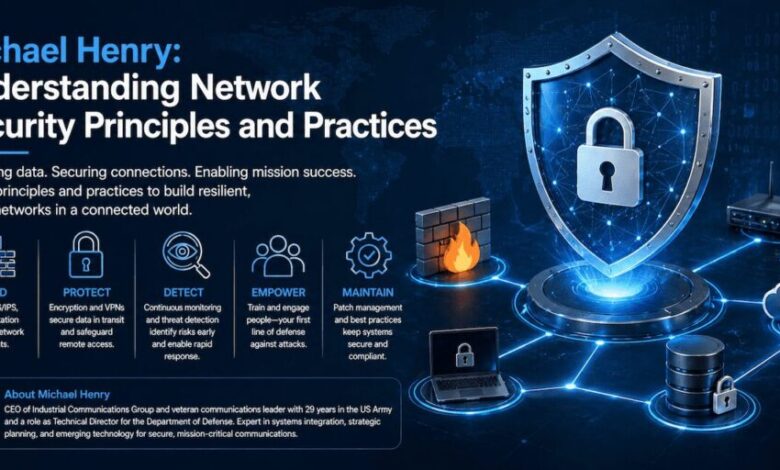
Michael Henry is a Virginia Beach-based communications professional and executive with decades of experience in military and government environments. As CEO of Industrial Communications Group, he oversees systems integration, personnel, and strategic planning, drawing on a career that includes nearly 30 years in the US Army and a leadership role as a technical director with the DOD. Michael Henry has worked extensively on global communications initiatives, including projects supporting Special Operations Command, where secure and reliable networks are critical. His background in tactical communications, combined with experience in private sector technologies such as 4G and 5G systems, provides a strong foundation for understanding the complexities of modern network security and the importance of safeguarding critical data and infrastructure.
Understanding Network Security
Network security is the practice of protecting the confidentiality, integrity, and availability of data transmitted across networks. As organizations increasingly rely on interconnected systems, cloud platforms, and remote access, networks have become both essential for productivity and attractive targets for malicious actors. Network security combines multiple strategies and technologies to protect users and systems from evolving threats.
A proactive approach to network security is important since it helps protect sensitive data. Organizations handle, store, and share sensitive data, including intellectual property, financial records, and clients’ personal information. Without adequate safeguards, this information can be intercepted by malicious actors who can use it for extortion or sell it for financial gain. Implementing effective network security mitigates this risk and encourages the public to trust a company with their personal information, which is crucial for customer loyalty and competitive advantage.
Network security also protects a company’s operational continuity. Network disruptions, whether caused by external malicious attacks or internal misconfigurations, can negatively affect business activities. In most cases, downtime translates into financial losses and reduced productivity. Effective network security minimizes these risks by detecting anomalies early and enabling rapid responses.
Implementing effective network security measures also contributes to regulatory compliance. Most governments and industry entities have established standards that dictate how data is handled and protected. Failing to meet these expectations attracts penalties, restrictions, or legal consequences, all of which are costly for organizations. Network security provides the suitable mechanisms to balance operational and profitability goals with these regulations to demonstrate accountability.
Several tools help organizations secure their networks, including firewalls. These act as gatekeepers by controlling incoming and outgoing traffic based on predefined rules. Firewalls block unauthorized access to network resources, helping protect data, computers, software, and storage systems from malicious actors.
Intrusion detection and prevention systems add another layer of defense by monitoring network traffic for unusual activity that may indicate malicious intent. They can alert administrators and, when properly configured, automatically block or mitigate threats. This visibility is essential for identifying both external attacks and internal risks.
Encryption tools are essential for protecting data in transit by converting it into unreadable formats that can only be accessed with the correct key. Protocols such as Hypertext Transfer Protocol Secure (HTTPS) and Transport Layer Security (TLS) ensure that transmitted data remains secure, even if intercepted by unauthorized parties.
Virtual private networks (VPNs) are also important for securing network resources. With the rise of remote work, employees and stakeholders often access centralized systems from different locations, increasing the risk of data interception. VPNs help protect against eavesdropping by creating secure connections, allowing operations to continue safely across distributed environments.
While these resources are popular in mitigating network attacks, three primary strategies determine the effectiveness and success of using these tools. One such technique is network segmentation. Entities should segment networks into smaller, isolated zones to contain breaches and limit the lateral movement of attackers within the network. By dividing the network into distinct segments based on function or sensitivity level and implementing firewalls and access controls between segments, organizations can minimize the impact of a potential breach.
Patch management for network software can also minimize vulnerability to attacks. Regularly updating software and systems with the latest security patches is essential for addressing known vulnerabilities. Entities should establish patch management processes to promptly deploy patches and updates across their IT infrastructure, minimizing the risk of exploitation.
Lastly, employee training and awareness can mitigate attacks. Human error is a significant contributor to security breaches. Comprehensive training programs can educate employees about common threats to network resources, empowering them to recognize and report suspicious activities.
About Michael Henry
Michael Henry is the CEO of Industrial Communications Group in Virginia Beach, Virginia, with extensive experience in military and government communications. He served 29 years in the US Army as a special operations communicator and later worked as a technical director for the Department of Defense, leading global communications initiatives. His background includes systems integration, strategic planning, and emerging technology deployment. He holds an MBA from Embry Riddle University and a degree in economics from the University of California, Davis.