Unlocking productivity: the power of visual collaboration tools for modern teams
Modern teams operate in environments where ideas move quickly, and collaboration often spans different locations and time zones. In this context, visual collaboration tools have become increasingly important for organizing thoughts, mapping workflows, and aligning group efforts.
By translating abstract ideas into shared visual formats, these tools help teams communicate more clearly and reduce misunderstandings, making it easier to progress from concept to execution.
With remote and hybrid work arrangements becoming more common, the need for structured yet flexible collaboration methods has grown. Teams often rely on shared digital spaces to generate ideas, evaluate options, and refine solutions collectively.
An online brainstorming tool can support this process by allowing participants to contribute in real time or asynchronously, ensuring that diverse perspectives are captured without the limitations of physical meetings.
This approach encourages more inclusive participation and helps maintain continuity in ongoing projects across different stages of development over a longer time.
Benefits of visual collaboration
Embracing visual teamwork yields tangible improvements for organizations of every size:
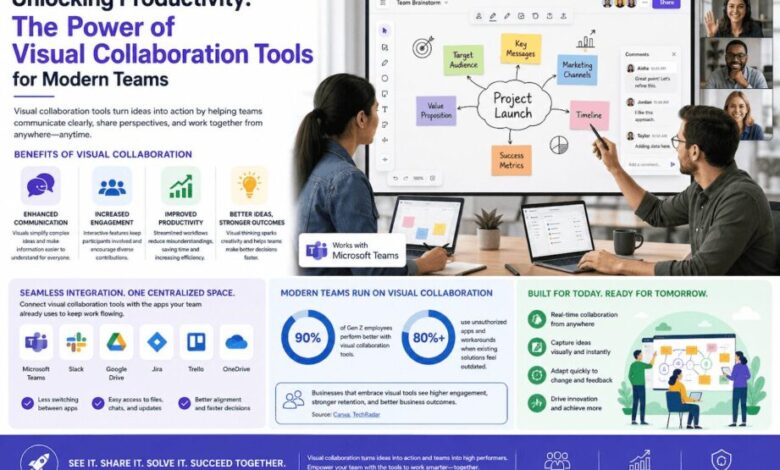
- Enhanced Communication: Visual aids such as diagrams and whiteboards clarify complex concepts, making it easier to grasp at a glance what lengthy written instructions might struggle to explain.
- Increased Engagement: Interactive features maintain participant focus and give every team member a way to contribute. This results in higher-quality discussions and ensures diverse perspectives are considered.
- Improved Productivity: Workflows become more streamlined, and common misunderstandings are more readily identified and corrected, saving time and reducing costly errors.
Many leading organizations now consider visual collaboration essential. Integrating these tools with platforms like Microsoft Teams, for instance, has proven to boost productivity and foster creativity.
Integrating visual tools with existing platforms
Efficient workflows depend on reducing the friction of switching between applications. Integrating visual collaboration tools with established platforms consolidates resources, ensuring that work happens in a centralized environment.
This means fewer distractions and less time wasted toggling between apps. Employees can see project timelines, add comments, and reference relevant documents all in one place.
Seamless integration not only minimizes training needs but also encourages adoption across teams. Whether it’s connecting with project management software, chat tools, or file sharing systems, unified platforms help teams move faster and make better decisions.
Industry studies show that organizations prioritizing integration experience higher employee satisfaction and more consistent project delivery.
This streamlined approach also supports better alignment across teams by keeping information consistent and easily accessible. When data and discussions are housed in a single environment, the risk of miscommunication is significantly reduced.
It also allows teams to adapt more quickly to changes, since updates are visible in real time. Over time, this contributes to a more organized, predictable workflow that supports long-term project stability.
Adapting to modern workforce preferences
Generational shifts in the workforce have made visual and digital-first collaboration more than just a convenience, they are now a necessity.
Early-career professionals, especially those from Generation Z, are more comfortable using digital diagrams, virtual whiteboards, and AI-driven apps than navigating long email threads or static text documents.
According to Canva research, 90% of Gen Z employees perform better with visual collaboration tools. Additionally, over 80 percent turn to unauthorized apps and workarounds when existing solutions feel outdated.
This not only introduces shadow IT risks but also signals a clear need for companies to modernize their tech stack to keep top talent engaged and productive.
As explored in TechRadar’s feature, businesses not ready for this change struggle to retain high-performing employees who expect digital and visual solutions as the baseline for effective work.
This shift also reflects a broader expectation for intuitive and visually oriented digital environments in everyday work. As younger professionals enter leadership pipelines, these preferences are increasingly influencing organizational standards and tool selection.
Companies that fail to adapt may experience gaps in collaboration efficiency and employee satisfaction. Over time, aligning workplace systems with these expectations becomes an important factor in maintaining competitiveness and retaining skilled talent.
Conclusion
Visual collaboration platforms are helping organizations adapt to new work norms by making communication more vivid and participatory.
By integrating these digital tools with the platforms teams already use and staying attuned to workforce preferences, businesses can foster a culture of innovation and maximize both engagement and productivity.
In an era defined by constant change, the shift to visual collaboration is becoming a strategic imperative for success.