IPhone 15 Pro: A Practical, Honest Deep Dive
If you’re looking at the iPhone 15 Pro right now, there’s a decent chance you’re doing the same thing most of us do: trying to figure out whether it’s still a smart buy, or just “last year’s Pro” with a fancy name. I get it. The iPhone 15 Pro is still a seriously capable phone, but it also sits in that awkward zone where stock, pricing, and real-world value matter as much as the specs.
This guide is written for people who want the facts, yes, but also the context. The goal is to help you decide: should you buy it, which version makes sense, and what you should plan for (accessories, storage, and a few quiet gotchas).
iPhone 15 Pro: what you’re really buying
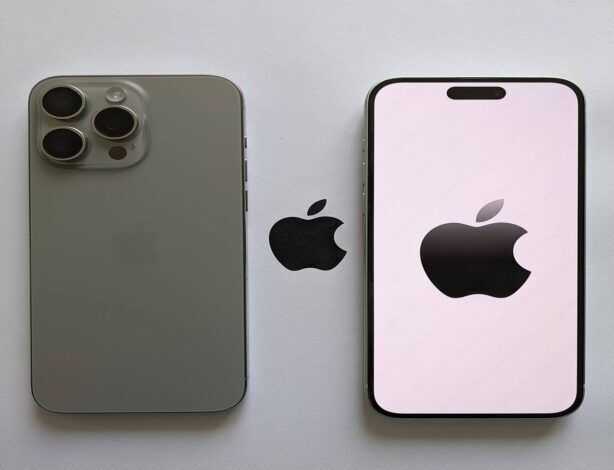
On paper, the iPhone 15 Pro is “just” a 6.1-inch Pro iPhone. In practice, it’s the smallest iPhone that still gets the full Pro treatment: a top-end chip, a high-refresh display, a more flexible camera setup, and little quality-of-life extras that add up over time.
It’s also a phone that tends to make sense for a certain kind of person: someone who takes a lot of photos and video, someone who edits content (even lightly), someone who keeps a phone for years, or someone who’s simply picky about the way a phone feels day to day. Not everyone needs that. Some people absolutely do.
If you’re already wondering “Do I need the Pro at all?” you’ll probably enjoy this comparison: iPhone 15 Pro vs iPhone 15. It’s not meant to push you either way. It’s just a clearer way to see what you actually gain.
Design, durability, and the stuff you notice daily
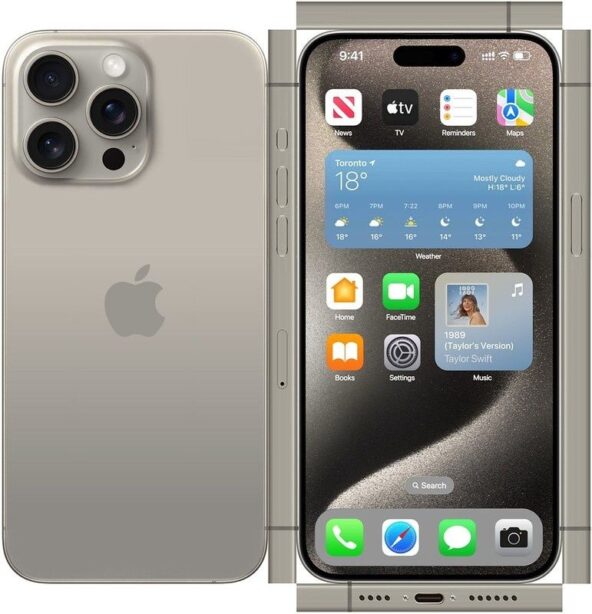
Apple leaned into titanium for the iPhone 15 Pro, and the result is a phone that feels a bit more “tool-like” than jewelry-like. That’s a compliment, mostly. It’s less slippery than some older models, and it doesn’t feel as dense in the hand as prior stainless-steel Pro iPhones.
Here are a few physical details that help ground expectations:
- Size: 146.6 mm tall, 70.6 mm wide, 8.25 mm thick.
- Weight: 187 grams.
It’s also rated IP68 for water and dust resistance (up to 6 meters for up to 30 minutes). That sounds bulletproof. It’s not. Think of it as “insurance against accidents,” not permission to treat the phone like an action camera.
The display: one of the easiest “Pro” upgrades to feel
The iPhone 15 Pro uses a 6.1-inch Super Retina XDR OLED display with a 2556-by-1179 resolution at 460 ppi. It supports Always-On display and ProMotion with adaptive refresh rates up to 120Hz.
If you’ve never used a 120Hz iPhone, ProMotion can feel like a small luxury that you stop noticing… until you pick up a 60Hz phone again. Scrolling is smoother, animations look more natural, and the whole OS feels a touch more responsive. It’s not a necessity. But it’s one of those upgrades that’s hard to “un-feel.”
Brightness also matters more than people admit, especially outdoors. Apple lists 1,000 nits typical max brightness, 1,600 nits peak brightness for HDR, and up to 2,000 nits peak brightness outdoors. That’s the difference between squinting at your screen and just… using your phone normally.
Performance and longevity: A17 Pro in real terms
The iPhone 15 Pro runs on the A17 Pro chip, with a 6-core CPU (2 performance cores + 4 efficiency cores), a 6-core GPU, and a 16-core Neural Engine. Numbers like that can blur together, so here’s the practical version: the phone has headroom. It stays fast longer, handles heavy apps better, and generally feels less “close to the edge” after a couple years of updates.
And yes, this matters even if you’re not gaming. It shows up in camera processing speed, video editing, multitasking, and how smoothly the phone holds up as iOS grows more demanding.
One more thing that’s worth a pause: Apple lists Apple Intelligence support for iPhone 15 Pro (and Pro Max) as part of iOS 18, with availability depending on language and rollout timing. If you care about on-device AI features and you want the lowest-cost iPhone that’s in that club, this model is part of the conversation.
Camera and video: where the iPhone 15 Pro earns its name
Most people buy the iPhone 15 Pro for the camera system, even if they say they’re buying it for “performance.” And honestly, that’s fair. The camera setup gives you more creative flexibility, and it tends to deliver more consistently across tricky lighting.
Here’s what Apple lists for the rear camera system:
- 48MP Main camera (24mm, ƒ/1.78) with sensor-shift optical image stabilization and support for 24MP and 48MP photos.
- 12MP Ultra Wide (13mm, ƒ/2.2) with 120° field of view.
- 12MP 2x Telephoto (48mm) enabled by the quad‑pixel sensor.
- 12MP 3x Telephoto (77mm, ƒ/2.8).
In use, this translates to a simple advantage: you get more “good options” without thinking too hard. Ultra Wide for tight spaces and landscapes, Main for everyday, and a real Telephoto option when you don’t want to walk closer or you’re shooting a portrait and want more flattering perspective.
iPhone 15 Pro camera basics (without the hype)
Here’s the part people don’t always say out loud: most smartphone cameras look great in ideal daylight. The difference shows up when the lighting gets weird. Restaurants. Indoor events. Backlit scenes. Night shots that you still want to look like real life.
The iPhone 15 Pro leans on computational photography features like Photonic Engine, Deep Fusion, Smart HDR 5, Night mode, and LiDAR-assisted Night mode portraits. The names are a mouthful, but the outcome is straightforward: more keepers, fewer “almost” shots.
If you shoot a lot of portraits, the Telephoto options matter more than megapixels. Perspective and focal length are what make faces look natural. And, in a slightly contradictory way, the best portrait camera is sometimes the one that makes you stop overthinking and just take the photo.
Video workflow: the quiet reason creators love it
The iPhone 15 Pro supports 4K video recording up to 60 fps, Cinematic mode up to 4K HDR at 30 fps, HDR video with Dolby Vision up to 4K at 60 fps, and ProRes video recording up to 4K at 60 fps with external recording. It also supports Log video recording and ACES (Academy Color Encoding System).
That sounds very “film school,” but it basically means this phone can be a serious capture device when you want it to be. The ProRes + external recording angle is especially interesting if you record a lot, because storage becomes a real issue fast. Which is why we’ll talk about storage in a minute, and why USB‑C matters more than it first appears.
USB‑C, charging, and accessories (avoid the small traps)
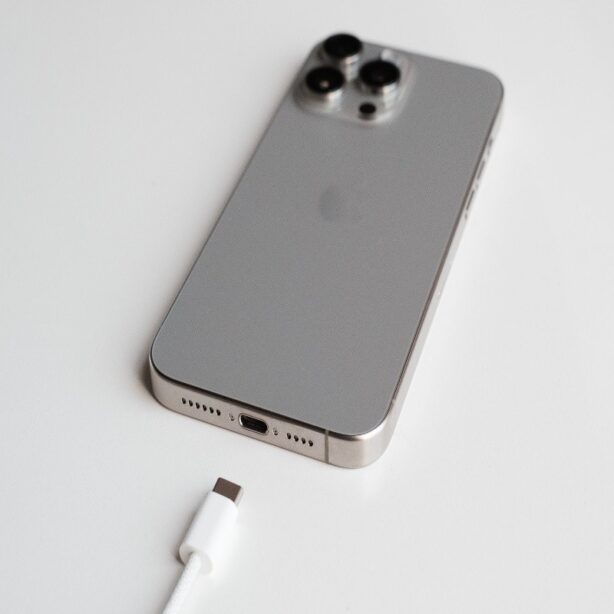
The iPhone 15 Pro uses a USB‑C connector, and it supports USB 3 speeds up to 10Gb/s. If you transfer big video files, that’s a big deal. If you don’t, you might never notice. Both realities can be true.
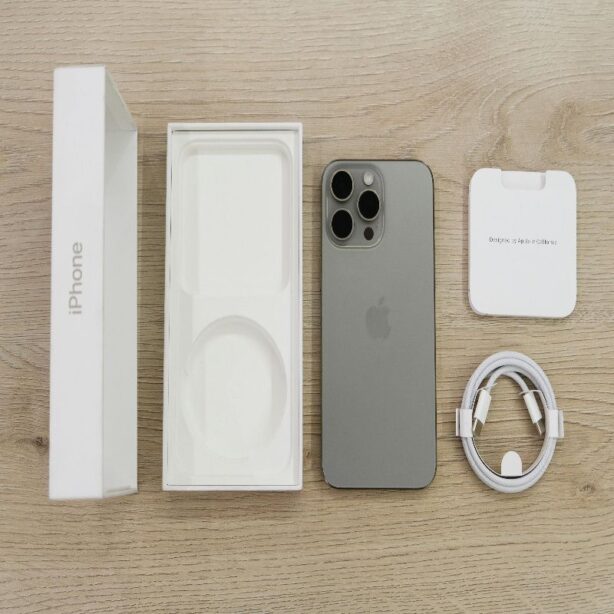
What’s in the box matters too, because it shapes what you’ll spend after the purchase. Apple includes an iPhone 15 Pro, a 1-meter USB‑C Charge Cable, and documentation. It does not include a power adapter or EarPods.
If you want to keep things simple, you can use any compatible USB‑C power adapter. Apple also notes fast charging: up to 50% charge in around 30 minutes with a 20W adapter or higher (sold separately). That’s the practical threshold where charging stops being annoying.
Wireless charging is here too: MagSafe up to 15W, Qi2 up to 15W, and Qi up to 7.5W. If you’ve never used MagSafe, it’s one of those features that seems unnecessary until you have a stand on your desk or a charger by the bed and the whole routine becomes… easier.
If you want a more specific guide on cables, speeds, and what to buy (without wasting money), this is worth a read: iPhone 15 Pro USB‑C and charging.
Battery life: solid, not magical
Apple lists up to 23 hours of video playback, up to 20 hours of streamed video playback, and up to 75 hours of audio playback. Real life will be lower, of course, depending on signal strength, screen brightness, apps, and whether you’re filming a lot.
The way I’d frame it: the iPhone 15 Pro battery is “reliably good” for a 6.1-inch phone. If you’re a heavy user, you’ll still have days where you top up in the afternoon. That’s not a failure. It’s just what heavy use looks like.
One note that matters for long-term ownership: batteries have limited recharge cycles and eventually need replacement. The best battery strategy is boring—avoid extreme heat, use optimized charging, and don’t stress about keeping it at 100% all the time.
Storage: the choice that sneaks up on people
Apple lists four storage tiers for iPhone 15 Pro: 128GB, 256GB, 512GB, and 1TB.
Here’s my slightly opinionated take (and I’ll admit it’s not perfectly universal): 128GB is fine if you mostly stream, use iCloud Photos, and don’t shoot loads of video. But if you film in 4K regularly, or you’re the person who keeps years of photos locally “just in case,” 256GB is where the phone starts to feel less constrained.
For creators, especially anyone experimenting with ProRes or longer shoots, 512GB and 1TB can make sense—less micromanaging, less offloading, fewer annoying storage warnings. It’s not glamorous, but it changes the experience.
Connectivity, SIMs, and travel basics
The iPhone 15 Pro supports 5G (sub‑6 GHz) with 4×4 MIMO, Wi‑Fi 6E, and Bluetooth 5.3. It also supports Dual SIM (nano‑SIM and eSIM) and dual eSIM.
If you travel or use a work/personal split, eSIM support is genuinely convenient. And if you’ve ever landed somewhere and needed data quickly, you’ll appreciate how much simpler eSIM can be than hunting for a shop and swapping tiny pieces of plastic.
Safety features: worth knowing, even if you never use them
Apple lists Emergency SOS via satellite and Crash Detection on iPhone 15 Pro. Ideally, these features stay invisible forever. But it’s still reassuring that they exist, and it’s one of those “Pro” features that feels more meaningful than a benchmark score.
Buying the iPhone 15 Pro in India (pricing, sellers, and sanity checks)
This is where things get real, because your buying experience might matter more than the phone itself. Since the iPhone 15 Pro is no longer the newest Pro iPhone, what you’ll see in the market can vary: different sellers, varying stock, and price swings that make it hard to know what’s “normal.”
Before buying, it’s worth doing a quick sanity checklist:
- Confirm the exact model, storage, and condition (new, refurbished, open-box).
- Check warranty status and return policy, not just the headline price.
- Budget for a charger if you don’t already have a good USB‑C one.
- If you’re buying for video work, budget for the right USB‑C cable and storage strategy.
For a more pricing-focused guide—what to pay, how to think about deals, and where people commonly buy—this post is designed to help: iPhone 15 Pro price in India.
So, is the iPhone 15 Pro still worth it?
I think the iPhone 15 Pro is still a great buy for a specific audience: people who want a smaller Pro phone, care about camera flexibility, value the 120Hz display, and plan to keep the device for years. The fundamentals are strong—A17 Pro performance, a bright ProMotion display, and a camera system that’s versatile enough to grow with you.
But it’s not the default recommendation for everyone. If you’re not going to use the Telephoto lens, don’t care about ProMotion, and mostly live in messaging, streaming, and casual photos, you might be happier saving money on a non‑Pro model. And that’s not settling. That’s just buying what you’ll actually use.
If you’re close to buying, the final decision usually comes down to two things: price and storage. Get those right, and the iPhone 15 Pro can feel like a “smart purchase” rather than an impulse.