
Innovations in Clean Energy: The Role of Solid Oxide Fuel Cells
Understanding Solid Oxide Fuel Cells
As global industries intensify their efforts to combat climate change, the adoption of advanced clean energy technologies has become crucial. Solid oxide fuel cells (SOFCs) are among the most compelling options for reliable, environmentally friendly power generation. Spearheaded by leading innovators such as KR Sridhar, SOFCs are positioned to lead the transition toward a more sustainable energy future. SOFCs differ from other fuel cell types primarily by their high-temperature operation, which ranges from 500°C to 1,000°C. This unique characteristic allows them to generate sufficient heat to enhance system efficiency while using an electrochemical process to convert fuels such as hydrogen or natural gas directly into electricity.
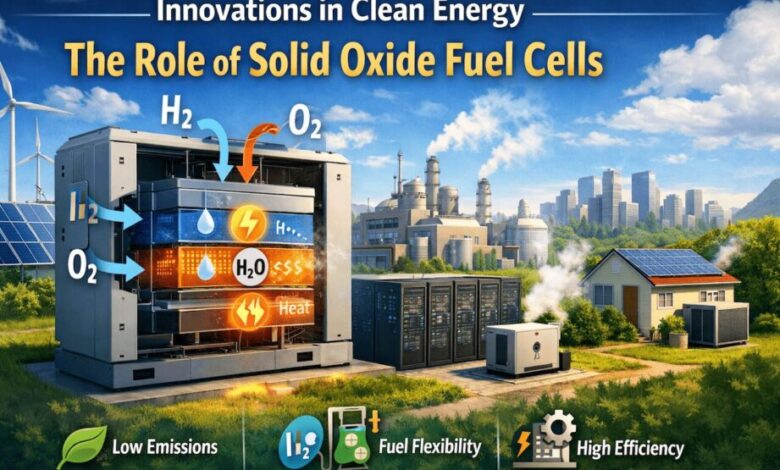
SOFCs generate electricity through a reaction between fuel and oxygen ions, producing water and heat, with no combustion involved, thus reducing pollutants like nitrogen oxides and particulates. This clean, efficient process supports global emissions goals and the transition to sustainable power, using various fuels like hydrogen or natural gas. Their high efficiency lowers fuel use and costs, making them suitable for diverse applications from industrial to residential. As R&D advances, SOFC deployments are expected to increase amid evolving climate policies and sustainable investments.
Advantages of SOFC Technology
Solid oxide fuel cells (SOFCs) offer significant technical and economic benefits and are highly regarded in clean energy dialogues. They achieve electrical efficiencies exceeding 60%, surpassing those of traditional combustion generators, and can achieve higher overall efficiencies when heat is used in combined heat and power systems. SOFCs offer fuel flexibility, operating on various fuels such as biogas and hydrogen, enabling them to adapt to changing market demands and local energy resources. Their electrochemical process reduces emissions, improving air quality and public health. Additionally, SOFC systems are scalable, ranging from kilowatt units for residential use to megawatt-scale units for industrial applications, promoting installation versatility across multiple market segments. These attributes establish SOFC technology as vital in modernizing energy infrastructure and advancing toward net-zero emissions targets.
Applications Across Industries
SOFC (Solid Oxide Fuel Cell) systems are increasingly used across various industries, providing tailored solutions for clean, reliable power. In the commercial and industrial sectors, these systems help businesses reduce the risks associated with grid volatility, delivering the energy independence essential for operations that require constant uptime. For data centers, SOFCs ensure an uninterrupted, efficient electricity supply, critical for maintaining IT services. Homeowners can take advantage of integrated combined heat and power (CHP) systems that use SOFC technology to generate on-site electricity and hot water, resulting in lower energy bills and greater reliability during outages. The rise of distributed energy solutions has also led to the consideration of SOFCs for microgrids and remote sites with limited access to centralized power, showcasing their adaptability and performance in urban and off-grid environments, thereby enhancing overall energy resilience.
Challenges and Future Prospects
Despite their promising attributes, SOFCs are not without challenges. The high operating temperature, while beneficial for efficiency, can stress system materials, leading to durability concerns and higher initial costs. Current research efforts are focused on overcoming these technical hurdles through novel ceramic and composite material innovations. Additionally, scaling up production and optimizing manufacturing processes are essential steps to further decrease costs and promote wider commercial adoption.
Looking ahead, experts believe that ongoing advancements in SOFC technology will enhance system lifespans, cut costs, and broaden the range of viable fuels. Strategic policy support, robust market investment, and public-private partnerships are also essential factors in accelerating SOFC deployment globally. These improvements could solidify SOFCs’ status as a key solution for countries seeking cleaner, more reliable energy alternatives in both established and developing regions.
Conclusion
Solid oxide fuel cells are establishing themselves as a vital pillar in the world’s transition to a clean energy economy. With outstanding efficiency, broad fuel compatibility, and ultra-low emissions, SOFCs are poised to play a significant role in transforming power generation across industrial, commercial, and residential settings. By overcoming current technical and economic challenges through continuous innovation and collaboration, SOFCs will remain at the forefront of sustainable energy solutions for decades to come.